Choosing a Digital Marketing Course in 2026: 5 UAE Programs Compared
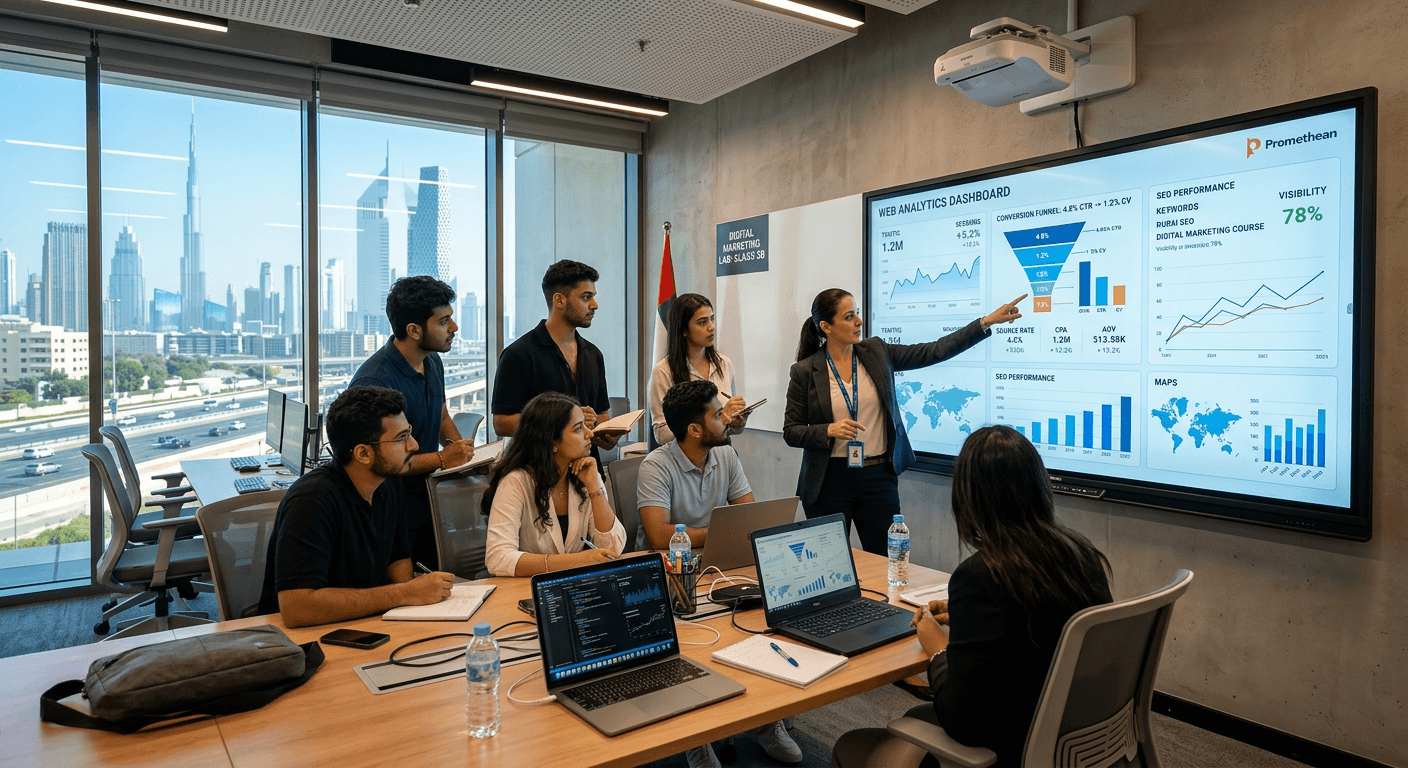
A marketing manager sits across from an external agency reviewing a monthly performance report, realizing they cannot distinguish a legitimate organic traffic increase from automated bot spikes. This is the exact moment a digital marketing course transitions from an optional resume builder into a strict operational necessity. As search algorithms shift toward intent-based logic and hyper-local focus across the UAE, professionals face a widening gap between textbook theory and actual technical execution. Closing that gap requires understanding which educational programs deliver hands-on campaign capability and which merely issue certificates.
Quick Summary
Selecting the correct educational pathway depends on whether you require hands-on technical skills or standardized corporate certification. A practical program bridges the gap between traditional strategy and modern digital execution in regional markets.
- Vocational training focuses strictly on operational skills and immediate campaign deployment.
- Certification prep standardizes marketing vocabulary for enterprise compliance.
- Immersive bootcamps build in-house technical capabilities to replace external agencies.
- Hybrid academic models combine creative asset production with technical digital distribution.
Table of Contents
- Quick Summary
- How to Choose
- 1. LIIMS Institute
- 2. Morgan International
- 3. AstroLabs Academy
- 4. SAE Institute Dubai
- 5. IIDE - The Digital School
- Where your tactical requirements leave you
| Product | Educational Delivery Model | Features | Pros | Cons | Target Audience |
|---|---|---|---|---|---|
| LIIMS Institute | Vocational Training | Live campaign management, regional intent focus | - Hands-on platform execution<br>- GCC market specific<br>- Immediate skill application | - Lacks global accreditation<br>- Limited theoretical depth<br>- Geographically constrained | Local GCC practitioners |
| Morgan International | Certification Prep | Global frameworks, standardized exams | - Internationally recognized<br>- Enterprise compliance focus<br>- Broad strategic overview | - Minimal hands-on execution<br>- Rigid curriculum structure<br>- Abstract theory heavy | Corporate marketing teams |
| AstroLabs Academy | Immersive Bootcamp | Live data audits, intensive pacing | - Replaces outsourced agencies<br>- Uses real company data<br>- Direct instructor feedback | - Extremely time intensive<br>- High burnout risk<br>- Requires dedicated focus | Startup founders and in-house teams |
| SAE Institute Dubai | Hybrid Academic | Media compression, visual distribution | - Strong creative foundation<br>- Asset production pipeline<br>- Technical distribution | - Less technical architecture<br>- Heavy arts focus<br>- Longer duration | Content marketers and media producers |
| IIDE - The Digital School | Vocational Training | Digital whiteboards, live teardowns | - Scales across locations<br>- Enforced remote participation<br>- Flexible scheduling | - Zero physical networking<br>- Screen fatigue risk<br>- Requires strong internet | Distributed remote teams |
How to Choose
A digital marketing course is not a monolith. Approaching this market requires understanding exactly how the instruction is delivered, as the format dictates your immediate capacity to execute live campaigns. The classification lens for this evaluation is the Educational Delivery Model, which breaks down into four distinct categories:
- Vocational Training: Built entirely around immediate, hands-on execution. These programs strip away theoretical padding to focus on platform mechanics, bidding strategies, and tactical deployment. You learn how to run an seo marketing course of action directly inside a staging environment.
- Certification Prep: Designed for corporate environments where standardized knowledge is mandatory. These pathways prioritize overarching frameworks and global compliance, ensuring that a team in Dubai speaks the exact same strategic language as a team in London.
- Immersive Bootcamp: High-velocity, intensive environments intended to replace outsourced agency work by building formidable in-house capabilities. They force students to work on their actual business data rather than hypothetical scenarios.
- Hybrid Academic: Blends traditional creative arts and media production with digital distribution. This category recognizes that technical optimization fails if the underlying creative assets do not convert the user.
Practical rule: Never buy an educational program based on the specific software interface it uses; buy it for the methodology it teaches, as platform layouts change every quarter.
1. LIIMS Institute
An e-commerce founder in Deira watches customer acquisition costs double over a single quarter, prompting an immediate search for actionable, localized training. LIIMS Institute operates directly in this reality as a digital marketing training provider based in Dubai.
Instructors force students into live advertising accounts to map hyper-local intent across the GCC market. Instead of debating abstract buyer personas, the curriculum tackles regional search structures, Arabic language keyword nuances, and immediate campaign deployment logistics. You actively analyze actual regional traffic drops, configure local bidding rules, and adjust daily spend caps inside staging environments. The focus shifts entirely away from memorizing definitions and centers on what a practitioner actually clicks on a Tuesday morning to stop a bleeding budget.
Regional execution outranks global theory
Operating strictly as Vocational Training, this provider abandons the broad, global standardization multinational corporations expect from personnel. The curriculum is purely Dubai-based. This leaves structural gaps if you suddenly manage campaigns for audiences in North America or Europe. Cultural and algorithmic search behaviors diverge significantly from the Middle East. Professionals needing credentials recognized outside the MENA region hit a rigid ceiling here. Coursework sacrifices international theory to achieve local depth.
I would deploy this for junior staff who need to manage live UAE budgets by next week. The focus remains entirely local.
Enroll here to build immediate, hands-on campaign execution skills specifically tuned to the GCC market.
Pros
- Prioritizes live platform execution over abstract definitions
- Curriculum maps directly to GCC search behaviors
- Enables immediate application to active marketing budgets
Cons
- Excludes deep international market theory
- Lacks the academic accreditation required by strict corporate HR
- Narrows professional focus heavily toward localized geography
2. Morgan International
Enterprise marketing teams often stall when half the department understands programmatic bidding and the other half relies on traditional media buys. Standardizing that vocabulary is exactly what Morgan International handles, operating globally as a professional education provider offering certification preparation and diploma programs.
The instruction centers entirely on preparing participants for internationally recognized exams rather than navigating the weekly interface changes of specific advertising platforms. Students dissect overarching marketing frameworks, strict corporate compliance standards, and multi-channel attribution models that govern enterprise-level spending. You learn how to structure a secure data pipeline conceptually, mapping how user data flows from a landing page to a centralized CRM, rather than writing the SQL queries yourself. The goal is building a robust, defensible strategy that can withstand an executive board review.
Corporate standardization requires rigid frameworks
Passing a standardized exam, however, does not equate to knowing how to salvage a penalized domain in the wild. Because it sits firmly in the Certification Prep category, the heavy theoretical emphasis frustrates practitioners who need to audit backlink profiles or fix broken tracking tags today. When a server goes down or a tracking pixel fails to fire, theoretical frameworks offer zero immediate utility. Theory outweighs immediate practice.
What would make me hesitate is sending a solo operator here when they actually require immediate revenue generation tactics.
Choose this pathway when enterprise promotion or corporate compliance requires a globally verified credential.
Pros
- Aligns perfectly with international corporate hiring standards
- Bridges communication gaps between siloed enterprise departments
- Provides a secure, defensible foundation in marketing theory
Cons
- Offers almost zero hands-on technical execution
- Requires memorization of frameworks rather than live testing
- Frustrates professionals looking to solve immediate algorithmic penalties
3. AstroLabs Academy
Scaling a startup eventually forces a breaking point where relying on external agencies becomes too slow and opaque for sustainable growth. AstroLabs Academy replaces that outsourced dependency by functioning as a regional digital training academy offering courses in digital business, marketing, and tech.
The curriculum aggressively forces students to pull live data from their own company platforms rather than relying on sanitized, predictable case studies. Participants audit their current search visibility, rewrite their technical architecture, and fundamentally restructure their conversion funnels under direct instructor supervision. Integrating external optimization workflows, such as those used by RapidWombat - AI-Driven SEO for UAE Businesses, often becomes part of these practical audits to demonstrate how automation handles local search intent at scale. You are actively repairing your own business while learning the underlying mechanics.
In-house capability replaces outsourced execution
The intense velocity, however, demands significant time away from daily operational tasks, making it a heavy logistical burden for small teams. Teams attempting to run a full-time marketing department while simultaneously absorbing this dense, fast-paced material frequently burn out before the final module. As an Immersive Bootcamp, the pacing is aggressive and unforgiving. If you miss a week of instruction, the compounding nature of the technical curriculum makes catching up nearly impossible without external help.
I would steer clear of this format if your goal is simply a high-level executive overview of digital trends.
Commit to this intensive format to internalize technical capabilities and permanently reduce external agency reliance.
Pros
- Forces practical application on your actual business assets
- Rapidly accelerates technical competence within a single quarter
- Eliminates the need for basic external retainer contracts
Cons
- Requires unsustainable time commitments during the active cohort
- Carries a high probability of student burnout
- Punishes absentees due to the compounding technical curriculum
4. SAE Institute Dubai
Where bootcamps focus strictly on tactical execution and spreadsheet data, academic institutions recognize that conversion still requires compelling visual assets. SAE Institute Dubai is a creative media educational institution in the UAE offering digital media and online marketing courses.
The syllabus merges audio recording, video editing, and graphic design production directly with technical distribution models. Students learn to compress rich media specifically for site speed. They optimize creative visual elements for algorithmic search engine indexation. You structure full campaigns around high-fidelity content. You build the raw asset in a studio environment. Next, you map its digital delivery path across organic and paid channels. This ensures the creative vision survives the technical upload process.
Content production demands technical distribution
Marketers looking to master complex server-side rendering, advanced log file analysis, or deep algorithmic penalty recovery will find the curriculum far too heavily weighted toward the creative arts. Representing the Hybrid Academic model, the technical depth essentially stops once the media is successfully published, properly tagged, and actively tracked. If your daily operations require reverse-engineering a competitor's programmatic bidding algorithm, this environment will feel misaligned with your technical goals. Creative production leads the curriculum.
I would hold off on this route if your primary bottleneck is site architecture rather than content quality.
Invest in this academic pathway to blend high-quality media creation with standard digital distribution tactics.
Pros
- Ensures marketing assets actually look professional before distribution
- Connects creative arts directly to trackable digital metrics
- Provides access to professional-grade studio production workflows
Cons
- Limits instruction on deep technical site architecture
- Stretches the learning timeline beyond short-term tactical needs
- De-emphasizes heavy data science and log analysis
5. IIDE - The Digital School
Assuming self-paced video modules automatically translate into operational execution often leaves distributed teams with completion badges but zero campaign experience. IIDE - The Digital School dismantles that assumption by delivering an online and hybrid structure to teach its digital marketing classes.
Students navigate a highly structured combination of pre-recorded foundational theory and live, trainer-led practical sessions that refuse to let attendees passively watch. The platform forces real-time interaction through digital whiteboards and live advertising account teardowns, ensuring remote participants actually log in, configure tracking pixels, and set precise bidding rules. You learn the mechanics of digital visibility by breaking down live, failing campaigns in a shared digital environment, identifying exact points of friction while the instructor monitors your screen.
Remote delivery requires enforced participation
Relying heavily on digital delivery, however, means professional networking happens entirely through a screen, removing the spontaneous, high-value connections built in physical classrooms. Professionals looking to secure immediate, in-person GCC agency roles or meet their next local business partner lose the undeniable physical proximity advantage that localized physical campuses provide. Like any remote Vocational Training, screen fatigue is a genuine risk that diminishes retention. Staring at complex analytics dashboards over a video feed for hours requires a level of strict discipline that self-paced learners rarely possess.
I would prioritize this for geographically dispersed teams who cannot commute to a central office every evening.
Select this hybrid option to upskill distributed marketing staff without interrupting their daily operational schedules.
Pros
- Scales seamlessly across multiple remote locations simultaneously
- Forces active participation rather than passive video consumption
- Fits around existing full-time employment schedules
Cons
- Destroys organic, in-person networking opportunities
- Demands high self-discipline to combat screen fatigue
- Relies entirely on the stability of digital infrastructure
Where your tactical requirements leave you
Selecting the right curriculum is a matter of mapping your current operational bottlenecks directly to the correct delivery model.
If your bottleneck is immediate campaign performance, Vocational Training provides the shortest path to execution. Practitioners taking these digital marketing classes leave with the ability to configure tags, map regional intent, and manage live budgets without waiting for academic semesters to conclude. This works perfectly when you need to fix a bleeding ad budget by Friday.
When your barrier is corporate red tape or a lack of standardized internal vocabulary, Certification Prep solves the structural issue. This path ensures that enterprise teams operate on the same verified frameworks, removing the friction that occurs when different departments use conflicting metrics to report on the same campaign.
Founders tired of paying retainers for opaque results must lean into the Immersive Bootcamp model. The time investment is heavy, but it fundamentally shifts the capability in-house, allowing teams to audit and repair their own digital infrastructure without waiting for an agency to respond to a ticket.
Finally, teams producing heavy volumes of media who struggle to gain traction will benefit from a Hybrid Academic approach. By linking creative production directly to technical distribution, this route ensures that high-quality assets actually reach the intended target audience, solving the problem of beautiful content that nobody ever sees.